

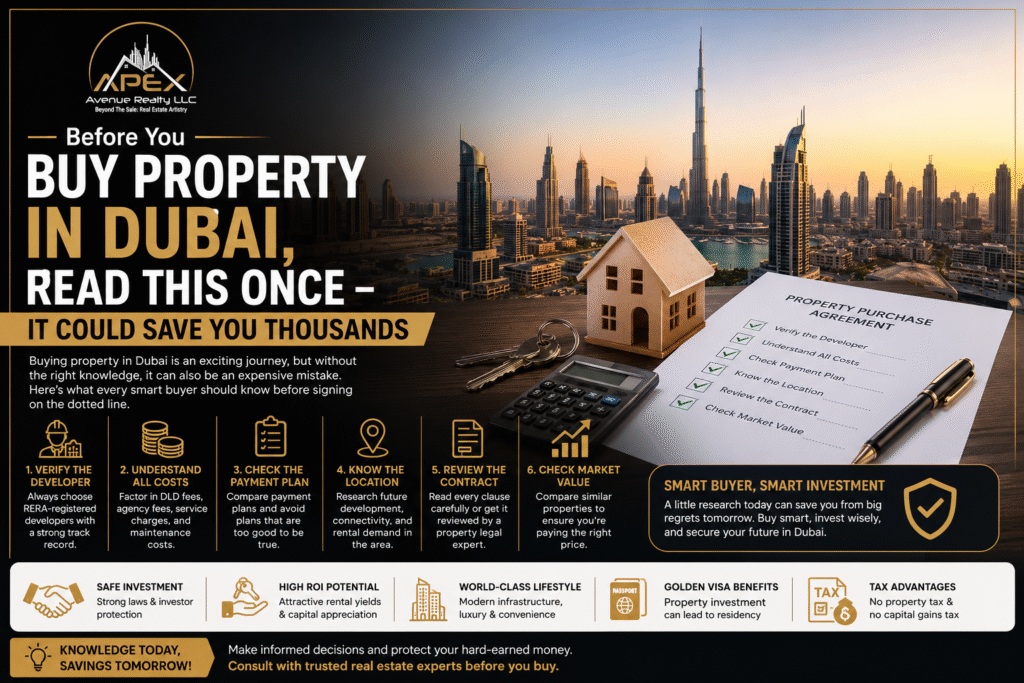
Before You Buy Property in Dubai, Read This Once – It Could Save You Thousands
Sir, this unit won’t be available tomorrow.”
If you’ve visited a property showroom in Dubai, you’ve probably heard a sentence like this.
Sometimes it’s true.
Many times, it isn’t.
Now imagine this.
You walk into a beautifully designed sales gallery. Large screens display breathtaking views of the skyline. A scale model of the community sits in the centre of the room. Fresh coffee is served. The sales consultant tells you this project has already sold 70% of its units and that prices are expected to increase next week.
Within an hour, you’re looking at floor plans.
Within two hours, you’re calculating payment plans.
Before the day ends, you’re seriously considering paying a booking amount.
Everything feels exciting.
Everything looks perfect.
But here’s the question very few buyers ask:
“Am I buying the right property, or am I simply buying a great sales presentation?”
That single question can save you thousands of dirhams.
After researching Dubai’s property market, analysing different communities, comparing developers, and understanding what separates successful investments from disappointing ones, one thing becomes very clear.
Most buyers don’t lose money because Dubai is a bad market.
They lose money because they make decisions too quickly.
Dubai remains one of the world’s most attractive real estate markets. It offers modern infrastructure, investor-friendly regulations, tax advantages, world-class developments, and communities designed for almost every lifestyle. Yet the opportunities that make Dubai exciting also make it easy to choose the wrong property if you don’t know what to look for.
This guide isn’t about convincing you to buy.
It’s about helping you buy wisely.
Because in real estate, the property you don’t buy is often just as important as the one you do.
Buying Property Is Easy. Buying the Right Property Is Difficult.
Search online for apartments in Dubai and you’ll find thousands of listings.
Luxury apartments.
Beachfront homes.
Golf course villas.
Townhouses with attractive payment plans.
Ready properties.
Off-plan launches.
Every project claims to offer:
- High ROI
- Prime location
- Strong capital appreciation
- Flexible payment plans
- World-class amenities
If every advertisement were completely accurate, every property in Dubai would be the perfect investment.
But real estate doesn’t work that way.
Two apartments in neighbouring buildings can produce completely different rental returns.
Two villas with similar layouts can appreciate at different rates over five years.
Two projects launched by different developers may have entirely different handover experiences.
The difference isn’t always visible in the brochure.
It’s hidden in the details.
That’s why experienced investors spend more time researching than purchasing.
The Biggest Mistake First-Time Buyers Make
Most people start with one question:
“What property can I afford?”
Experienced buyers ask something different.
“What property will still make sense five years from now?”
Those are completely different approaches.
Buying based only on today’s budget often leads buyers towards attractive offers without considering future resale value, rental demand, maintenance costs, or neighbourhood growth.
Imagine buying an apartment simply because it was AED 150,000 cheaper than similar options elsewhere.
At first, it feels like a great deal.
Three years later, you discover that rental demand is weak, service charges are higher than expected, and nearby developments have created stronger competition.
The cheaper purchase may end up costing far more over time.
Smart buying isn’t about finding the lowest price.
It’s about finding the best long-term value.
Don’t Fall in Love With the Show Apartment
Developers design show apartments for one purpose.
To help you imagine your future life there.
The furniture is carefully selected.
Lighting is professionally designed.
Every room feels larger than expected.
The experience is meant to create an emotional connection.
There’s nothing wrong with that.
But emotions should never replace research.
Instead of asking,
“How beautiful is this apartment?”
ask questions like:
- How much are the annual service charges?
- How many similar units are currently available?
- What is the average rental occupancy?
- Is the surrounding area still under construction?
- How has the developer performed on previous projects?
- Are future transport links planned?
- What infrastructure will exist after completion?
These questions don’t sound exciting.
But they often determine whether your investment performs well.
Location Doesn’t Mean a Famous Address
Many buyers assume famous locations automatically produce the best investment returns.
That’s not always true.
Downtown Dubai is iconic.
Dubai Marina is internationally recognised.
Palm Jumeirah is world-famous.
Yet depending on your goals, another community may offer stronger rental demand, lower entry prices, and better long-term growth.
For example, a young professional may prioritise access to Metro stations and business districts.
A family may care more about schools, parks, healthcare, and community facilities.
An investor may focus on rental yield rather than prestige.
The “best location” depends entirely on why you’re buying.
Buying for lifestyle and buying for investment are rarely the same decision.
The Cheapest Property Is Rarely the Best Deal
Everyone loves a bargain.
Real estate is different.
If one property is significantly cheaper than every comparable option nearby, there is usually a reason.
Perhaps:
- Higher maintenance costs
- Less desirable layout
- Lower rental demand
- Limited transport access
- Smaller developer reputation
- Future oversupply
Instead of asking why a property is cheap, ask why other buyers aren’t choosing it.
That question often reveals far more than the asking price itself.
Payment Plans Can Be Misleading
A flexible payment plan feels attractive.
Pay 10% today.
Another 10% later.
The rest spread over several years.
It sounds comfortable.
But payment plans should never be the reason you buy a property.
The property itself must justify the investment.
Some buyers become so focused on monthly instalments that they forget to evaluate the project’s long-term value.
A great payment plan cannot fix a poor investment.
Think Beyond Handover Day
Many buyers believe their journey ends when they receive the keys.
In reality, ownership begins at handover.
Questions worth asking include:
How much will annual maintenance cost?
How competitive is the rental market?
Will new developments affect resale prices?
How quickly are similar properties being rented?
What future infrastructure projects are planned nearby?
Thinking beyond handover separates homeowners from investors.
Investors plan for what happens after purchase.
Research the Developer Like You’re Hiring a Business Partner
When buying off-plan, you’re placing trust in a developer long before receiving a finished property.
That’s why reputation matters.
Look beyond advertisements.
Research previous projects.
Check delivery timelines.
Study construction quality.
Understand customer feedback.
Consistency matters more than marketing.
A developer with a strong history of delivering quality projects often provides greater confidence than one making ambitious promises for the future.
Hidden Costs Surprise More Buyers Than Property Prices
The purchase price is only part of the investment.
Buyers should also understand the additional costs associated with ownership, such as registration charges, service fees, financing expenses where applicable, maintenance, insurance, and moving costs.
Ignoring these expenses can put unnecessary pressure on your budget.
Planning for the total cost of ownership—not just the purchase price—helps avoid unpleasant surprises later.
Ask Yourself One Simple Question
Imagine the market slowed down tomorrow.
Would you still be happy owning this property?
If the answer is yes, you’ve probably chosen based on quality.
If the answer depends entirely on future price increases, you may be relying too heavily on market speculation.
The strongest investments continue making sense even when markets become quieter.
A Property Should Fit Your Goal, Not Someone Else’s
Every buyer has a different objective.
Some want rental income.
Some want capital appreciation.
Some want a family home.
Others want a holiday property.
The same apartment cannot be perfect for every purpose.
That’s why copying another investor’s purchase isn’t always the right decision.
The best property is the one that supports your financial goals, lifestyle, and long-term plans.
Final Thoughts
Dubai offers extraordinary opportunities for buyers. It is home to world-class communities, innovative developments, and a property market that continues to attract investors from around the globe.
Yet the smartest buyers understand one important truth.
Buying property isn’t a race.
The pressure to “book today” or “secure the last available unit” should never replace careful research.
Take time to compare communities.
Understand the developer.
Study market trends.
Look beyond glossy brochures.
Ask difficult questions.
Think about where the area could be five or ten years from now—not just how impressive the showroom looks today.
Because a well-chosen property can support your financial goals for years to come.
A rushed decision can become an expensive lesson.
Before you buy property in Dubai, pause for a moment.
Research first.
Decide second.
That simple habit may save you thousands—and help you choose a property you’ll be confident owning for years to come.