

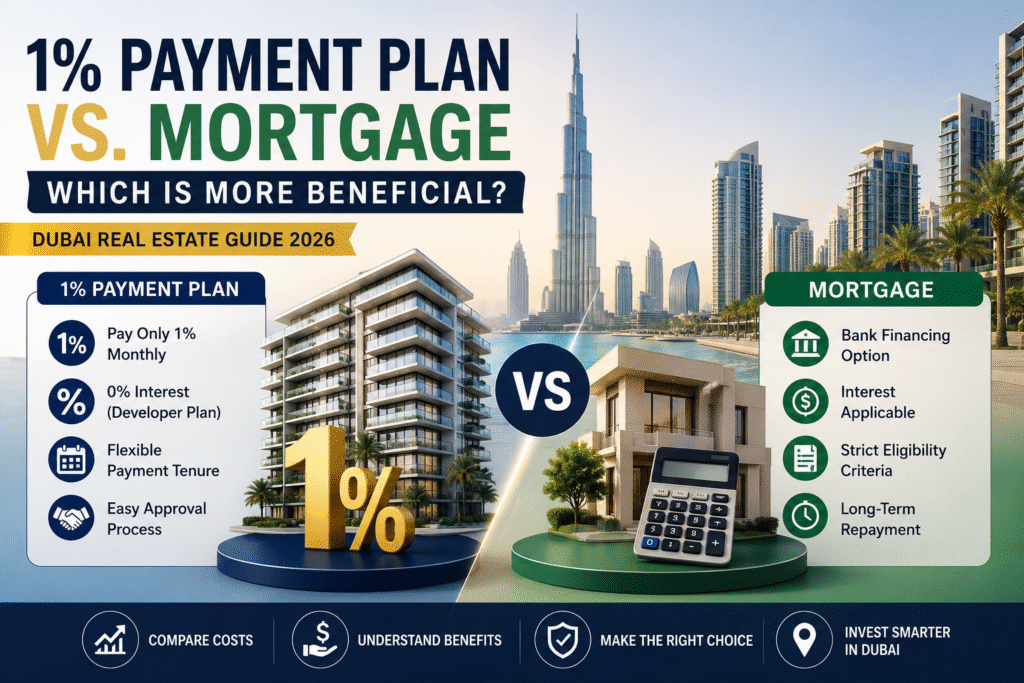
Dubai’s property market has evolved far beyond the traditional buy-and-sell model. Flexible financing solutions, investor-friendly regulations, long-term residency options, and high rental demand have transformed the emirate into one of the world’s most accessible real estate investment destinations.
Among the most discussed financing options in 2026 are the 1% payment plan and the traditional mortgage.
Both allow buyers to enter Dubai’s real estate market, but they operate very differently. One prioritizes flexibility and lower bank dependency, while the other focuses on structured long-term repayment.
For investors, end-users, expatriates, and overseas buyers, choosing the right option can directly impact:
- Monthly cash flow
- Long-term profitability
- Rental yield potential
- Investment flexibility
- Total ownership cost
The right decision depends on your financial profile, investment strategy, income stability, and long-term goals.
This guide explains the real difference between a 1% payment plan vs mortgage in Dubai, including costs, advantages, risks, return potential, and which option may work better in today’s market conditions.
What Is a 1% Payment Plan in Dubai?
A 1% payment plan is a developer-backed financing structure where buyers pay small monthly installments directly to the developer instead of taking a bank loan.
Under this model, buyers usually pay:
- An initial booking amount or down payment
- Followed by monthly installments equal to approximately 1% of the property value
These plans are commonly available on:
- Off-plan apartments
- Newly launched projects
- Select ready properties
- Post-handover developments
Example of a 1% Payment Plan
Property Price: AED 1,000,000
- Down Payment: 20% (AED 200,000)
- Remaining Balance: AED 800,000
- Monthly Installment: AED 8,000
- Duration: Approximately 6–8 years
Unlike a traditional mortgage, payments are made directly to the developer rather than a financial institution.
This financing structure became highly popular in Dubai because it lowered the entry barrier for investors and first-time buyers.
What Is a Mortgage in Dubai?
A mortgage is a loan provided by a UAE bank or financial institution to finance property purchases.
The bank pays the seller or developer, while the buyer repays the bank through monthly installments over a long-term period, usually between 15 and 25 years.
Mortgage repayments include:
- Principal amount
- Interest charges
- Insurance and related banking fees
Example of a Mortgage Structure
Property Price: AED 1,000,000
- Down Payment: 20%
- Loan Amount: AED 800,000
- Interest Rate: 4%–5%
- Loan Tenure: 25 years
Monthly installments are generally lower than short-term developer plans because repayment is spread across decades.
1% Payment Plan vs Mortgage: Key Differences
| Feature | 1% Payment Plan | Mortgage |
|---|---|---|
| Financing Source | Developer | Bank |
| Interest Charges | Usually lower or built into price | Interest applied |
| Approval Process | Flexible | Strict bank assessment |
| Monthly Installment | Higher | Lower |
| Payment Tenure | Short to medium term | Long term |
| Ownership Structure | Depends on project terms | Registered immediately |
| Eligibility | Easier for many buyers | Salary and credit dependent |
| Ideal Buyer | Investors & entrepreneurs | Long-term residents |
| Property Type | Mostly off-plan | Ready & secondary market |
Why 1% Payment Plans Became Popular in Dubai
Dubai developers introduced flexible payment structures to attract a wider global audience.
This includes:
- Overseas investors
- Entrepreneurs
- Self-employed professionals
- First-time buyers
- Buyers without mortgage eligibility
The model gained momentum because many residents and investors wanted alternatives to:
- High interest payments
- Strict banking approvals
- Large upfront capital requirements
Several major developers now offer attractive post-handover payment structures, including:
- DAMAC Properties
- Emaar Properties
- Sobha Realty
- Danube Properties
- Azizi Developments
- Binghatti Developers
Benefits of a 1% Payment Plan
1. Reduced Dependence on Banks
One of the biggest advantages is avoiding traditional mortgage procedures.
Buyers who may not qualify for a bank loan due to income structure or credit profile can still access Dubai’s property market.
This is especially useful for:
- Freelancers
- Startup founders
- Business owners
- International investors
2. Lower Upfront Financial Pressure
Instead of paying a large amount immediately, buyers can spread payments over several years.
This improves liquidity and allows investors to:
- Preserve emergency funds
- Diversify investments
- Maintain business capital
- Manage cash flow more efficiently
3. Potentially Lower Overall Cost
Traditional mortgages can significantly increase the final property cost due to accumulated interest over 20–25 years.
Many developer payment plans are structured differently and may reduce the overall financing burden.
However, buyers should carefully review:
- Original property pricing
- Administrative charges
- Delayed payment penalties
- Post-handover conditions
Some developers may adjust property pricing within flexible payment structures.
4. Easier Entry Into Dubai Real Estate
Flexible payment plans have made property ownership accessible to a broader global audience.
This matters in fast-growing markets where waiting for mortgage approval or saving larger capital can result in higher future property prices.
Disadvantages of a 1% Payment Plan
1. Higher Monthly Commitments
Although these plans reduce upfront pressure, monthly payments can be substantial because repayment periods are shorter.
For example:
- AED 8,000–15,000 monthly payments are common for mid-range properties
Buyers must ensure these commitments remain sustainable over several years.
2. Mostly Limited to Off-Plan Projects
Many 1% payment plans are linked to off-plan developments.
This means buyers may need to wait for:
- Construction completion
- Handover timelines
- Rental income generation
Project delays can affect investment timelines.
3. Contract Terms Require Careful Review
Every developer follows different terms and conditions.
Buyers should evaluate:
- Handover clauses
- Ownership transfer conditions
- Late payment penalties
- Cancellation policies
Consulting a qualified real estate advisor or legal professional is strongly recommended.
Benefits of a Mortgage in Dubai
1. Lower Monthly Installments
Mortgage repayment periods are much longer, which usually reduces monthly financial pressure.
This is particularly beneficial for:
- Families
- Long-term residents
- End-users planning stable occupancy
2. Immediate Property Registration
With a mortgage, the property is typically registered in the buyer’s name once the transaction is completed.
This provides stronger ownership clarity and legal security.
3. Wider Property Selection
Mortgage financing is available for:
- Ready apartments
- Villas
- Townhouses
- Secondary market properties
- Luxury homes
This creates more flexibility when choosing locations and property types.
4. Better for Long-Term Wealth Planning
Many long-term residents prefer mortgages because they offer:
- Structured repayment schedules
- Predictable budgeting
- Long-term asset accumulation
Property appreciation over time can also strengthen long-term equity growth.
Drawbacks of Mortgages
1. Interest Costs Increase Total Repayment
Interest remains the largest disadvantage.
Over a 20–25 year period, buyers may pay hundreds of thousands of dirhams beyond the original property value.
This can significantly impact total ROI.
2. Strict Eligibility Requirements
Mortgage approval depends on:
- Salary level
- Employer category
- Credit history
- Existing debt obligations
- Bank statements
Self-employed buyers may face additional documentation requirements.
3. Additional Banking Fees
Mortgage buyers may encounter:
- Processing fees
- Valuation fees
- Mortgage registration fees
- Early settlement charges
- Insurance costs
These expenses should be factored into total ownership calculations.
Which Option Is Better for Investors?
The answer depends on investment strategy.
Investors Seeking Short-Term Growth
A 1% payment plan may work better for buyers focused on:
- Off-plan appreciation
- Portfolio expansion
- Flexible financing
- Lower initial investment
Dubai’s off-plan sector has attracted strong investor demand because many projects appreciate before handover.
Investors Focused on Long-Term Stability
Mortgages may suit buyers prioritizing:
- Stable long-term ownership
- Lower monthly commitments
- Established communities
- Rental income consistency
Ready properties financed through mortgages can generate immediate rental returns.
Which Option Is Better for First-Time Buyers?
For many first-time buyers in Dubai, developer payment plans appear more accessible because:
- Approval is easier
- Entry cost is lower
- Bank dependency is reduced
However, affordability should always be evaluated realistically.
A lower entry barrier does not automatically mean lower financial risk.
Buyers should assess:
- Future income stability
- Emergency reserves
- Existing liabilities
- Long-term financial obligations
Dubai Real Estate Market Trends in 2026
Dubai continues to attract global investors due to several major economic and lifestyle advantages.
Key market drivers include:
- Tax-efficient investment environment
- High rental yields
- Population growth
- Strong tourism sector
- Golden Visa opportunities
- Infrastructure expansion
- Investor-friendly regulations
Areas witnessing strong demand for flexible payment plans include:
- Dubai Hills Estate
- Jumeirah Village Circle (JVC)
- Business Bay
- Arjan
- Dubai South
- Al Furjan
- Dubailand
Meanwhile, ready property demand remains strong among end-users seeking mortgage financing.
Hidden Costs Buyers Should Not Ignore
Whether purchasing through a mortgage or payment plan, additional ownership costs must be considered.
These include:
- Dubai Land Department (DLD) fees
- Service charges
- Property maintenance
- Registration fees
- Real estate agency commission
- Home insurance
- Utility setup charges
Ignoring these expenses can impact long-term affordability and investment returns.
1% Payment Plan vs Mortgage: Cost Comparison
Scenario A: Mortgage Financing
Property Value: AED 1,000,000
Interest Rate: 4.5%
Loan Tenure: 25 Years
Estimated long-term repayment can exceed AED 1.5M depending on rates and fees.
Scenario B: 1% Payment Plan
Property Value: AED 1,000,000
Developer Payment Period: 7 Years
The total repayment may remain closer to the actual property price, although buyers should still verify whether pricing adjustments or hidden charges apply.
Who Should Choose a 1% Payment Plan?
A 1% payment plan may suit:
- Entrepreneurs
- Freelancers
- Overseas investors
- Buyers seeking flexible financing
- Investors expecting future income growth
- Buyers targeting off-plan appreciation
Who Should Choose a Mortgage?
A mortgage may suit:
- Salaried professionals
- Long-term UAE residents
- Families purchasing primary homes
- Buyers seeking predictable repayment schedules
- Buyers interested in ready properties
Expert Insight: Which Option Creates Better Long-Term Value?
From an investment perspective, neither financing method is universally superior.
The better choice depends on:
- Cash flow management
- Risk tolerance
- Property objective
- Investment timeline
- Financing eligibility
A 1% payment plan can create strong leverage opportunities in a rising market because buyers gain exposure to property appreciation without committing to immediate full financing.
Mortgages, on the other hand, may provide stronger financial stability for buyers planning long-term occupancy or steady rental income.
Experienced investors often evaluate:
- Expected rental yield
- Service charge impact
- Exit strategy
- Market appreciation trends
- Financing flexibility
before making a final decision.
Frequently Asked Questions
Is a 1% payment plan better than a mortgage in Dubai?
A 1% payment plan may be better for buyers seeking flexible financing without traditional bank dependency, while mortgages may suit buyers wanting lower monthly payments over longer periods.
What is the downside of a 1% payment plan?
Higher monthly installments and limited project availability are among the main disadvantages.
Is mortgage financing cheaper than a payment plan?
Monthly mortgage costs are usually lower, but long-term interest payments can increase the total repayment amount significantly.
Can foreigners get a mortgage in Dubai?
Yes. Expatriates and overseas investors can apply for UAE mortgages subject to bank eligibility criteria and approval.
Are 1% payment plans interest-free?
Many developer plans are promoted as interest-free, but buyers should carefully review pricing structures and payment terms before signing agreements.
Which option is better for property investment in Dubai?
Developer payment plans are often preferred for off-plan investment strategies, while mortgages may suit long-term ownership and stable rental income goals.
Final Verdict
The comparison between a 1% payment plan vs mortgage in Dubai ultimately comes down to financial strategy rather than simply choosing the cheaper option.
A 1% payment plan offers:
- Greater flexibility
- Easier market entry
- Reduced dependence on banks
- Strong opportunities in off-plan investments
A mortgage offers:
- Long-term repayment stability
- Lower monthly financial pressure
- Immediate ownership registration
- Access to a wider range of ready properties
Dubai’s evolving real estate market now supports both strategies effectively, making property ownership increasingly accessible for local and international buyers.
The most successful investors focus not only on affordability but also on:
- Long-term ROI
- Rental yield potential
- Market timing
- Property location
- Financial sustainability
Choosing the right financing structure can directly influence investment performance, financial comfort, and long-term wealth creation in Dubai’s highly competitive property market.