


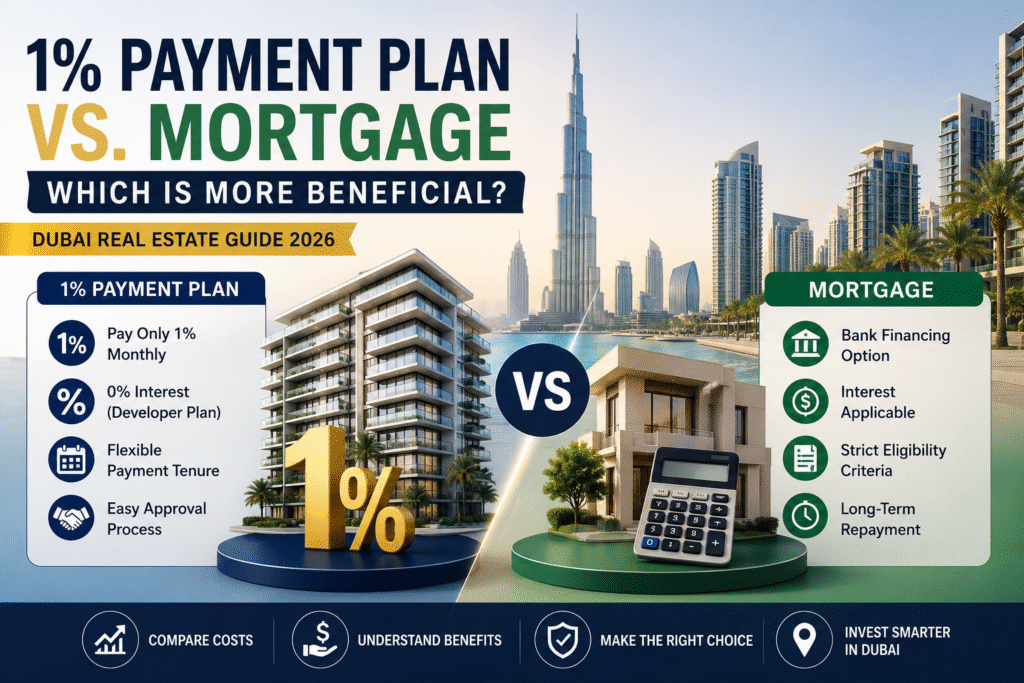
1% Payment Plan vs Mortgage in Dubai: Which Option Offers Better Value in 2026?
Dubai’s property market has evolved far beyond the traditional buy-and-sell model. Flexible financing solutions, investor-friendly regulations, long-term residency options, and high rental demand have transformed the emirate into one of the world’s most accessible real estate investment destinations. Among the most discussed financing options in 2026 are the 1% payment plan and the traditional mortgage. Both allow buyers to enter Dubai’s real estate market, but they operate very differently. One prioritizes flexibility and lower bank dependency, while the other focuses on structured long-term repayment. For investors, end-users, expatriates, and overseas buyers, choosing the right option can directly impact: The right decision depends on your financial profile, investment strategy, income stability, and long-term goals. This guide explains the real difference between a 1% payment plan vs mortgage in Dubai, including costs, advantages, risks, return potential, and which option may work better in today’s market conditions. What Is a 1% Payment Plan in Dubai? A 1% payment plan is a developer-backed financing structure where buyers pay small monthly installments directly to the developer instead of taking a bank loan. Under this model, buyers usually pay: These plans are commonly available on: Example of a 1% Payment Plan Property Price: AED 1,000,000 Unlike a traditional mortgage, payments are made directly to the developer rather than a financial institution. This financing structure became highly popular in Dubai because it lowered the entry barrier for investors and first-time buyers. What Is a Mortgage in Dubai? A mortgage is a loan provided by a UAE bank or financial institution to finance property purchases. The bank pays the seller or developer, while the buyer repays the bank through monthly installments over a long-term period, usually between 15 and 25 years. Mortgage repayments include: Example of a Mortgage Structure Property Price: AED 1,000,000 Monthly installments are generally lower than short-term developer plans because repayment is spread across decades. 1% Payment Plan vs Mortgage: Key Differences Feature 1% Payment Plan Mortgage Financing Source Developer Bank Interest Charges Usually lower or built into price Interest applied Approval Process Flexible Strict bank assessment Monthly Installment Higher Lower Payment Tenure Short to medium term Long term Ownership Structure Depends on project terms Registered immediately Eligibility Easier for many buyers Salary and credit dependent Ideal Buyer Investors & entrepreneurs Long-term residents Property Type Mostly off-plan Ready & secondary market Why 1% Payment Plans Became Popular in Dubai Dubai developers introduced flexible payment structures to attract a wider global audience. This includes: The model gained momentum because many residents and investors wanted alternatives to: Several major developers now offer attractive post-handover payment structures, including: Benefits of a 1% Payment Plan 1. Reduced Dependence on Banks One of the biggest advantages is avoiding traditional mortgage procedures. Buyers who may not qualify for a bank loan due to income structure or credit profile can still access Dubai’s property market. This is especially useful for: 2. Lower Upfront Financial Pressure Instead of paying a large amount immediately, buyers can spread payments over several years. This improves liquidity and allows investors to: 3. Potentially Lower Overall Cost Traditional mortgages can significantly increase the final property cost due to accumulated interest over 20–25 years. Many developer payment plans are structured differently and may reduce the overall financing burden. However, buyers should carefully review: Some developers may adjust property pricing within flexible payment structures. 4. Easier Entry Into Dubai Real Estate Flexible payment plans have made property ownership accessible to a broader global audience. This matters in fast-growing markets where waiting for mortgage approval or saving larger capital can result in higher future property prices. Disadvantages of a 1% Payment Plan 1. Higher Monthly Commitments Although these plans reduce upfront pressure, monthly payments can be substantial because repayment periods are shorter. For example: Buyers must ensure these commitments remain sustainable over several years. 2. Mostly Limited to Off-Plan Projects Many 1% payment plans are linked to off-plan developments. This means buyers may need to wait for: Project delays can affect investment timelines. 3. Contract Terms Require Careful Review Every developer follows different terms and conditions. Buyers should evaluate: Consulting a qualified real estate advisor or legal professional is strongly recommended. Benefits of a Mortgage in Dubai 1. Lower Monthly Installments Mortgage repayment periods are much longer, which usually reduces monthly financial pressure. This is particularly beneficial for: 2. Immediate Property Registration With a mortgage, the property is typically registered in the buyer’s name once the transaction is completed. This provides stronger ownership clarity and legal security. 3. Wider Property Selection Mortgage financing is available for: This creates more flexibility when choosing locations and property types. 4. Better for Long-Term Wealth Planning Many long-term residents prefer mortgages because they offer: Property appreciation over time can also strengthen long-term equity growth. Drawbacks of Mortgages 1. Interest Costs Increase Total Repayment Interest remains the largest disadvantage. Over a 20–25 year period, buyers may pay hundreds of thousands of dirhams beyond the original property value. This can significantly impact total ROI. 2. Strict Eligibility Requirements Mortgage approval depends on: Self-employed buyers may face additional documentation requirements. 3. Additional Banking Fees Mortgage buyers may encounter: These expenses should be factored into total ownership calculations. Which Option Is Better for Investors? The answer depends on investment strategy. Investors Seeking Short-Term Growth A 1% payment plan may work better for buyers focused on: Dubai’s off-plan sector has attracted strong investor demand because many projects appreciate before handover. Investors Focused on Long-Term Stability Mortgages may suit buyers prioritizing: Ready properties financed through mortgages can generate immediate rental returns. Which Option Is Better for First-Time Buyers? For many first-time buyers in Dubai, developer payment plans appear more accessible because: However, affordability should always be evaluated realistically. A lower entry barrier does not automatically mean lower financial risk. Buyers should assess: Dubai Real Estate Market Trends in 2026 Dubai continues to attract global investors due to several major economic and lifestyle advantages. Key market drivers include: Areas witnessing strong demand for flexible payment plans include: Meanwhile, ready property demand
1% Payment Plan vs Mortgage in Dubai: Which Option Offers Better Value in 2026? Read More »